
Key Highlights
- What in-house marketing means and where it works best
- What agency marketing offers that internal teams may lack
- The key differences between in-house marketing and agency marketing
- How to compare costs, skills, speed, and control
- When a hybrid model may be the better choice
- How to choose the right marketing setup for your business goals
Editor's Note: This post was originally published in June 2023 and has been updated with additional content about different types of landing pages in July 2026.
Choosing between in-house marketing vs agency marketing is a common challenge for business owners.
The right choice depends on your goals, budget, team size, and internal skills. A small start-up may need flexible outside support, while a growing company may benefit from building an internal team.
Both options have value. In-house marketing teams know your brand, customers, and daily priorities. Agency marketing teams bring outside expertise, extra resources, and support across SEO, paid ads, content, web design, and strategy.
The best decision starts with an honest review of your marketing goals and your team’s current strengths and gaps. At WSI, we use both in-house marketers and external specialists when the work calls for added support.
This guide breaks down the key pros and cons of in-house marketing vs agency marketing, so you can choose the right fit for your business.
| There is no single best choice between in-house marketing vs agency marketing. The right fit depends on what your business needs now, what skills you already have, and how fast you want to grow. |
What is In-House Marketing?
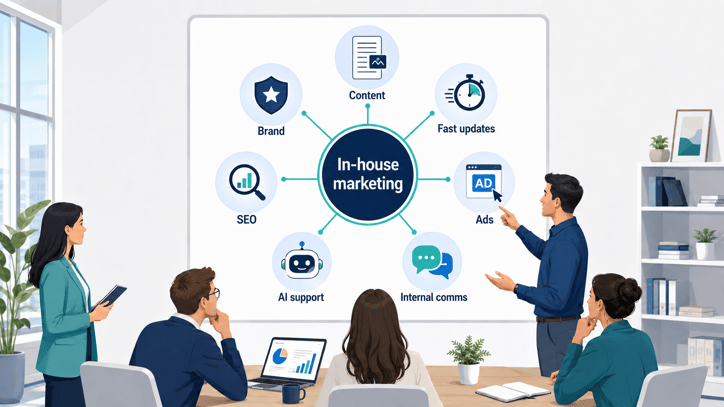
In-house marketing means your marketing operations are handled internally, by employees who are part of your organization. These might be generalists managing a bit of everything, or specialists dedicated to areas like social media, SEO, or content. Either way, they are on your payroll, immersed in your brand, and part of your regular team meetings.
Many businesses start with in-house marketing because it feels natural, you’re close to your brand, you understand your audience, and you want control over how your story is told. Totally fair. But like any business decision, there are pros and cons to consider.
Pros of In-House Marketing
- Let’s start with what’s great about keeping your marketing in-house:
Brand familiarity: Your team lives and breathes your company every day. They understand your voice, your values, and your quirks better than anyone else. - Speed and agility: Got a last-minute promo or a change in messaging? Maintaining an in-house team means you can usually pivot quickly without the back-and-forth of briefing an external team.
- Closer collaboration: Since they're already part of your team culture, in-house marketing teams can easily work with other departments, sales, customer service, and leadership to align on strategy
- Long-term strategy ownership: An in-house marketing department tends to take deeper ownership of ongoing strategies and can stay focused on long-term growth.
Cons of In-House Marketing
In-house marketing isn’t always the perfect solution. Here are the key drawbacks:
-
Higher Long-Term Costs: Salaries, benefits, and training for a full marketing team add up. You may also need to invest in tools and platforms that agencies already have access to.
-
Limited Skill Sets: In-house teams often lack the diverse expertise found in agencies (e.g., SEO, PPC, design, strategy, copywriting, analytics). Hiring specialists for every channel can be cost-prohibitive.
-
Slower Adaptation to Trends: Internal teams may not stay on the cutting edge of industry changes (e.g., new Google algorithms, AI tools, evolving social media platforms). Agencies are often better equipped to pivot quickly.
-
Resource Constraints: Small teams may be overloaded, leading to burnout and missed opportunities. When team members leave, it can disrupt campaigns or create knowledge gaps.
-
Limited Perspective: Being immersed in the company culture may limit fresh, outside-the-box thinking. Agencies often bring external insights and competitive benchmarking.
-
Scalability Issues: Scaling campaigns quickly (e.g., during product launches) may require more people than you have. Agencies can typically scale up or down based on project needs.
-
Recruitment and Retention Challenges: Finding and keeping top marketing talent is competitive and time-consuming. High turnover can stall projects and create inconsistency.
Best Use-Cases for an In-House Marketing Team
An in-house agency is best for work that is frequent, fast-moving, and close to the brand.
Best use-cases:
- High-volume content, such as social posts, emails, blogs, and sales materials
- Brand consistency, especially for product, legal, or executive messaging
- Fast campaign updates, such as promotions, events, landing pages, and paid ad edits
- Performance marketing support, including Google Ads, SEO refreshes, and reporting
- Local market adaptation for franchises, regions, or multi-location businesses
- AI-assisted production, such as first drafts, creative variants, and reporting summaries
- Internal communications, including HR, sales enablement, and company updates
| In-house marketing often works well when your business needs daily brand control, fast internal communication, and close alignment with sales or product teams. |
What is a Marketing Agency?

A marketing agency is a team of external professionals who offer specialized marketing services—anything from content creation and SEO to paid advertising and web development. Agencies can act as a full-on outsourced marketing department or simply support your existing in-house team with specific skills or campaigns.
Think of them as your extended marketing brain—one you don’t have to hire full-time or give a desk to. And the best part? A good agency doesn’t just execute; they bring strategy, structure, and fresh ideas to the table.
Pros of Agency Marketing
Here’s where agencies shine:
- Access to diverse expertise: You get a full team of specialists—designers, strategists, copywriters, SEO pros, you name it—without having to hire each one individually.
- Scalable support: Need a full-blown campaign next month? Agencies can ramp up quickly. Only need a little help with analytics or Google Ads? They can scale down too.
- Outside perspective: Agencies work with lots of clients across industries, so they bring fresh insights and best practices you might not have considered.
- Tools & tech: Agencies often have access to advanced tools and platforms that would be expensive or impractical for a single business to invest in.
Cons of Agency Marketing
Of course, working with an agency isn’t always smooth sailing. Here are some of the trade-offs:
- Less brand intimacy: An agency won’t be as embedded in your company culture as an internal team.
- Cost: Depending on the scope, outsourcing could stretch your marketing budget, though it may be more cost-effective in the long run.
- Communication lag: More formal processes may result in slower turnaround unless tightly managed.
- Finding the right fit: Not all digital marketing agencies work seamlessly with every business; choosing the right partner is essential.
Best Use-Cases for a Marketing Agency
A marketing agency is best when you need specialist skills, outside perspective, or extra capacity.
Best use-cases:
- Marketing strategy and planning
- SEO audits and long-term search growth
- Google Ads and paid social campaign management
- Website redesigns and conversion improvement
- Content strategy and content production
- Brand positioning and messaging
- Marketing automation and CRM setup
- Web accessibility reviews
- Analytics, reporting, and performance tracking
- Local SEO for multi-location businesses
- New product or service launches
- Extra support when your internal team is stretched
| Agency marketing can be a strong choice when you need specialist support, campaign management, SEO, paid search, content planning, or access to skills that are hard to hire internally. |
In-House Marketing vs. Marketing Agency Comparison
|
Criteria |
In-House Marketing |
Marketing Agency |
|
Cost |
High fixed costs (salaries, tools, benefits) |
Flexible cost structure; pay for services as needed |
|
Expertise |
May lack channel-specific specialists |
Access to diverse experts in SEO, PPC, design, content, etc. |
|
Scalability |
Harder to scale quickly without new hires |
Can easily scale services up or down |
|
Control |
Full control over strategy, tone, and branding |
Less direct control; collaboration required |
|
Speed of Execution |
May be slower due to limited resources |
Often faster due to a larger team and streamlined workflows |
|
Innovation |
May lag behind trends without ongoing upskilling |
Stays up-to-date with the latest tools, trends, and platforms |
|
Focus on Brand |
Deep understanding of the brand and internal culture |
May require onboarding time to understand the brand fully |
|
Recruitment & Retention |
Hiring and retaining talent can be challenging and costly |
No need to manage individual team members |
|
Tool Access |
Must purchase and manage all tools internally |
Agencies often provide access to premium tools and analytics |
|
Fresh Perspective |
Can become too internally focused |
Brings external insights and creative ideas |
Hybrid Approach: Best of Both Worlds
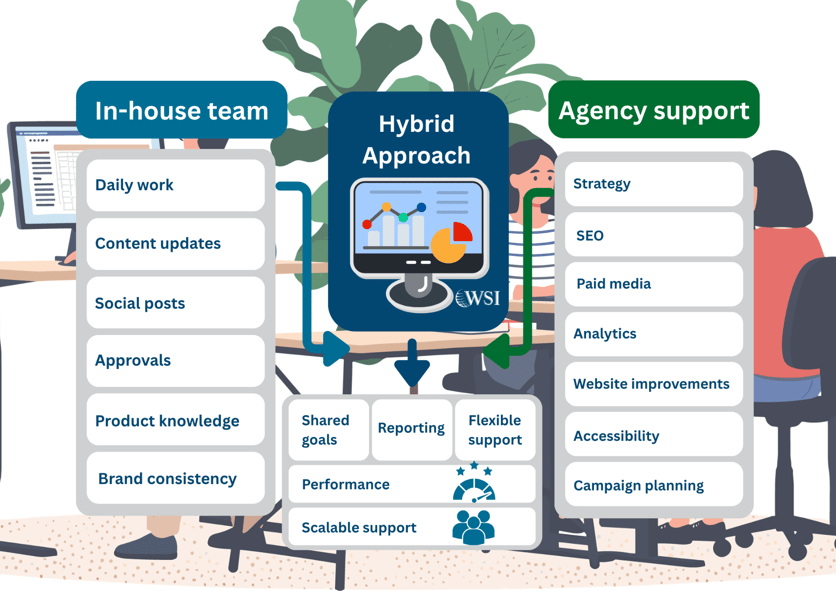
A hybrid approach gives your business the speed of an in-house team and the expertise of a marketing agency.
Your internal marketing team can manage day-to-day work, such as content updates, social posts, approvals, product knowledge, and brand consistency. This keeps your marketing close to the business and helps you move faster.
Your agency can support more complex work, such as strategy, SEO, paid media, analytics, website improvements, accessibility, and campaign planning. This gives you access to skills that may be hard or costly to build in-house.
This model works well when both teams have clear roles, shared goals, and regular reporting. The result is a more flexible marketing function that can respond quickly, improve performance, and scale support when needed.
| QUICK TIP: Before building a hybrid model, write down exactly which tasks stay in-house and which go to your agency. Clear ownership prevents duplicated work and missed deadlines. |
8 Key Business Factors When Comparing In-House vs Marketing Agencies
Factor #1: Your Company Culture, Vision, and Values
Most businesses want marketers who understand their culture, vision, and values, and that is easier to build with an in-house hire. A full-time employee is more invested in the company's growth than an external team working across multiple accounts. Agencies split their attention across several clients, so it takes longer for them to learn your day-to-day culture. In-house marketing keeps that alignment close, which is a real advantage over outsourcing.
Factor #2: The Need for Wide-Ranging Skill Sets
Your marketing strategy may need several skill sets, such as web development, social selling, email marketing, and pay-per-click advertising. Building an in-house team with all of these skills takes time and budget. Agencies already have specialists across these areas, so they can act as a one-stop shop. Recruiting, screening, and hiring a full in-house team takes patience, while an agency gives you that range of skills from day one.
Factor #3: The Dreaded Workplace Politics
Office politics are hard to avoid. Conflicts, distractions, and team dynamics can affect the quality of work when people work closely together every day. This is rarely a factor for an outside agency, since an agency team can focus only on your marketing strategy.
Factor #4: Keeping a Competitive Edge with Industry Best Practices
Digital marketing changes fast. Tactics that work today may not work next year, and competitors who adapt faster will get ahead. Agencies usually get earlier access to new tools, platforms, and marketing education, since staying current is part of their core service. In-house teams can fall behind without ongoing training and a budget for that education.
Factor #5: How Quickly Do You Need to Ramp Up Marketing?
Some situations need fast action. If a competitor launches a stronger website and you lose sales, you cannot wait through a hiring process to fix it. Posting a job, reviewing resumes, and running interviews takes weeks, while an agency can start work right away. Time-sensitive marketing problems are usually better handled by an agency.
Factor #6: A (Much) Larger Network of Brainpower
In-house marketers usually have a smaller network of outside contacts than a full-service agency. For supplementary work, such as customer service scripts, video production, or PR, an agency's network gives you access to resources that most in-house teams do not have.
Factor #7: Easy Communication
Clear communication keeps any marketing plan on track. In-house teams can schedule brainstorms, approvals, and meetings whenever needed, since everyone shares the same workspace. Agencies are less immediately available, since they manage several clients, but most run regular email, phone, and meeting cadences to cover results, projections, and planning. Both setups can work well, depending on what your team prefers.
Factor #8: Access to Tools and Platforms
A good agency already invests in the industry's key marketing tools and tests new platforms as they emerge. Building and maintaining that same tool stack in-house takes time and a meaningful annual budget. Outsourcing gives you access to those tools without managing the research, testing, or subscription costs yourself.
Cost Differences Between Marketing Agency vs In-House
Running marketing in-house adds up fast. You are not just hiring one person; you are building a team: salaries, benefits, office space, equipment, training, and software. A 4-person in-house marketing team typically costs $450,000–$550,000 a year, before tools and training.
Agencies make the cost simpler to plan. A monthly retainer or project fee usually includes access to top-tier tools, analytics platforms, and a ready team of specialists, often for $50,000–$150,000 a year for a comprehensive partnership. You are still investing, but it is a cleaner, more predictable spend that is easier to scale up or down as needs change.
| Do not compare salary to agency fees alone. Factor in tools, training, management time, recruitment, creative resources, reporting, and missed opportunities from limited capacity. |
The Benefits of Hiring an Agency vs Hiring a Person In-House
Experience across industries is one of an agency's biggest advantages. Agency teams work across many clients and channels, so they understand which platforms are worth your budget and how to run a campaign on them well.
Most businesses default to familiar channels, such as Facebook or Instagram. An agency might instead recommend a platform like Pinterest or TikTok based on your industry, products, or audience.
As an outside party, an agency can give an objective read on your business and build a strategy without the trial-and-error that often comes with a first in-house hire. Rather than testing approaches from scratch, an agency can put a working plan into action faster, which usually means a faster return on investment.
As a campaign progresses, an agency can use tools such as Google Analytics or social media management platforms to track performance on every channel. That ongoing optimization, built on experience across many accounts, tends to produce more followers, more shares, and more sales over time.
Why Invest in Digital Marketing
Digital marketing isn’t just “nice to have” anymore; it’s a core part of doing business in today’s world. Whether you're running a local bakery or a B2B tech company, your customers are online… and they expect you to be there too.
Investing in digital marketing is really about showing up where your audience is already hanging out—on search engines, social media, email, and beyond—and giving them a reason to connect with your brand.
But more than just being visible, digital marketing helps you:
- Attract the right audience: Not just any traffic—qualified traffic. The kind that’s actually interested in what you’re offering.
- Measure what’s working: Unlike traditional marketing, digital campaigns are trackable. You can see what’s bringing in leads, what’s converting, and what needs tweaking.
- Stay competitive: Your competitors are online, investing in content, SEO, and paid ads. If you’re not keeping up, you risk being invisible.
- Grow strategically: Whether your goal is more leads, higher sales, or better brand awareness, digital marketing helps you reach those goals in a measurable, scalable way.
And here’s the real kicker: digital marketing levels the playing field. You don’t need a massive budget to compete—just the right strategy.
Types of Digital Marketing Strategies
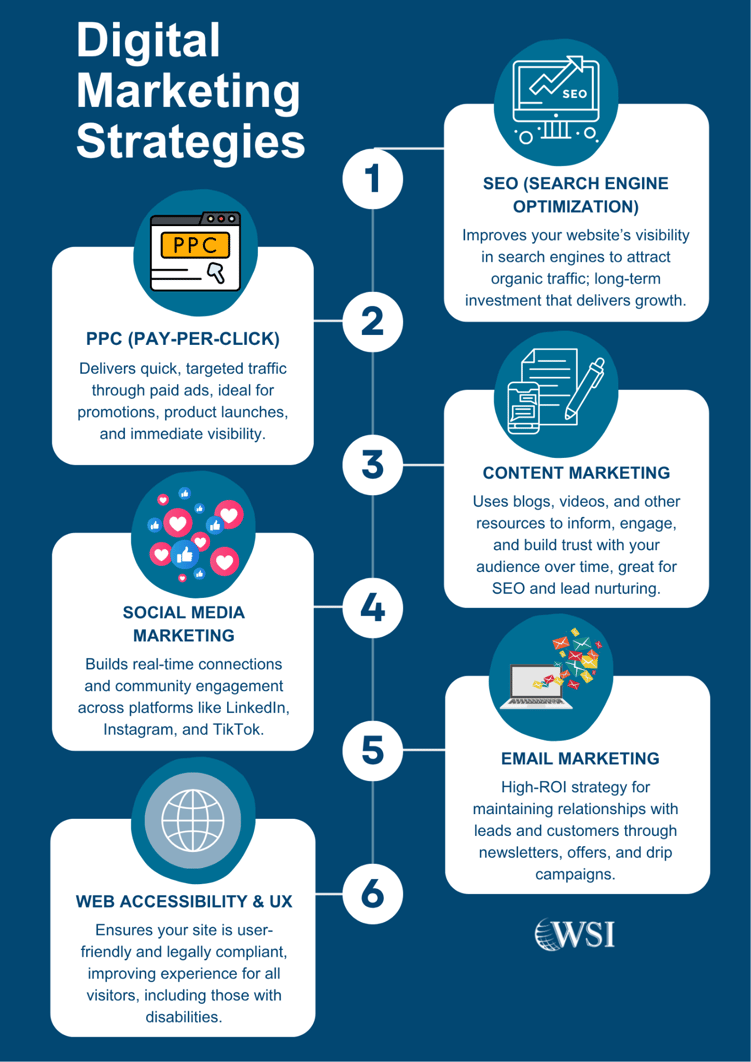
Digital marketing is a broad world, kind of like a digital toolbox filled with all sorts of strategies that work together to grow your brand. The trick is knowing which tools to use and when.
Here’s a quick rundown of the main types of digital marketing strategies (and what they’re good for):
Search Everywhere Optimization (SEO)
This is all about helping your website rank higher in search engines like Google so people can actually find you when they’re searching for things you offer. It's a long game, but it pays off big when done right.
Pay-Per-Click Advertising (PPC)
Want faster results? Paid ads (like Google Ads or social media ads) can drive targeted traffic almost instantly. Great for product launches, promotions, or getting quick visibility in a competitive space.
Content Marketing
Blog posts, videos, guides, webinars—this strategy is about creating valuable content that answers your audience’s questions and builds trust over time. It’s especially powerful for lead nurturing and SEO.
Social Media Marketing
Whether you're on LinkedIn, Instagram, or TikTok, social media helps you connect with your audience in real time. It’s not just about posting; it’s about engaging and building community.
Email Marketing
Still one of the highest-ROI strategies out there. Email is perfect for keeping in touch with leads, customers, and everyone in between. Think newsletters, drip campaigns, special offers—you name it.
Web Accessibility & UX
Not always top-of-mind, but crucial. Making sure your website is accessible and user-friendly isn’t just good practice—it’s good business (and in many places, it’s also the law).
AI-Enhanced Marketing
From chatbots to predictive analytics, AI can help automate tasks, personalize campaigns, and uncover insights you might miss manually. When used responsibly, it’s a game-changer.
Pitfalls of Hiring an In-House Marketing Team Instead of an Agency
- You will first have to find, interview, hire, and onboard these new employees. Then you will have to manage the overhead of their salaries, benefits, and time off.
- In-house marketers may not have a skill set as deep or broad as agency employees.
- If you need to scale up your marketing program rapidly, you may be slowed down by the process of finding and hiring more competent employees.
- It's highly likely and very common for in-house marketing teams to get stuck in a rut with creative styles and marketing strategies.
- If a vital member of your marketing team quits, your entire marketing program may freeze until you can find a suitable replacement.
| There is no universal right answer. Match your choice to your budget, growth stage, and the skills your team already has in place. |
Contact Our Online Marketing Agency Today!
In the end, the answer to the question of whether you should outsource your marketing team or keep it in-house is entirely dependent on your situation. When you go over our 8 key business factors of the in-house marketing vs. outsourcing marketing agency debate, do you find yourself, or your team, leaning one way or the other? That could be your answer.
If the list of pros and cons is equal on both sides, then you could be like the many businesses that do both. It never hurts to ask for help, especially in areas where you don't have an expert on the team or with new and trending tactics you're trying to gain a competitive edge with.
Outsourcing your marketing to an agency or going it alone can both be the correct, cost-effective decision that generates results for your business. If you're having trouble choosing between in-house marketing vs agency marketing, then speak to an expert at WSI today!